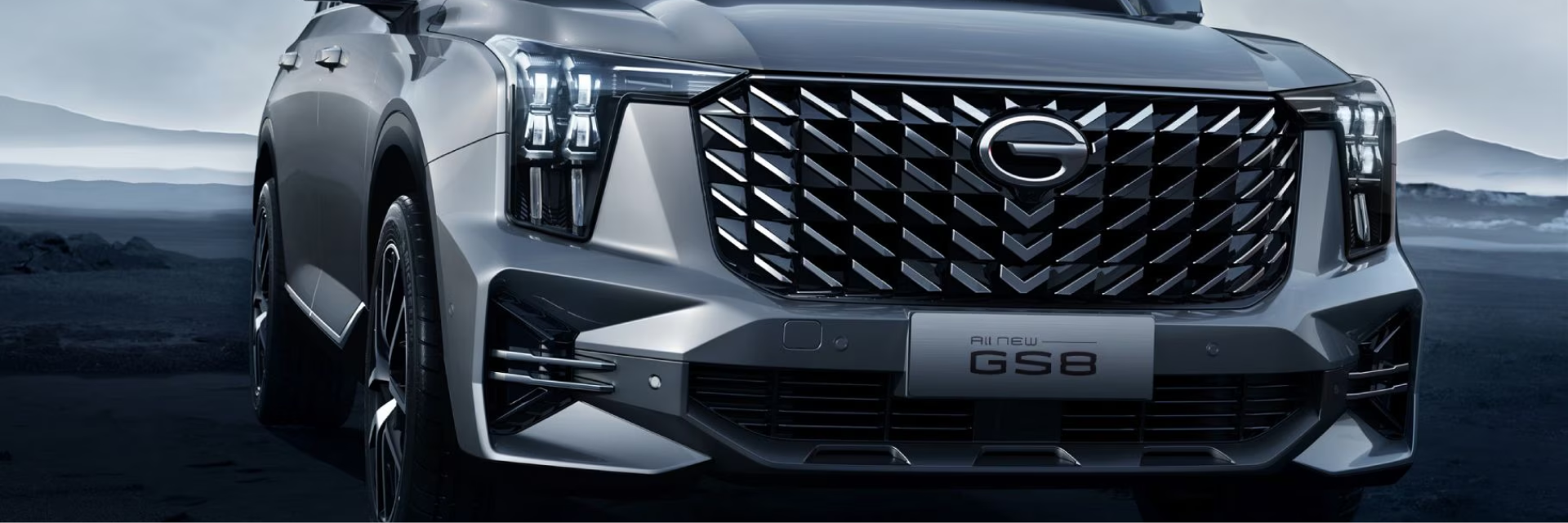
AWD vs. 4WD Cars: What's the Difference?
Choosing between AWD and 4WD is all about finding the perfect balance of performance and purpose. While both systems provide four-wheel power for greater grip and control, each is built for a different driving style. Understanding these capable drivetrains helps drivers choose the right blend of confidence, comfort, and capability for every journey.
In the UAE, understanding AWD vs. 4WD is key to choosing the perfect vehicle for your plans and pursuits. From daily drives through Dubai and Abu Dhabi to Hatta hilltop hikes and desert dune discoveries, the right drivetrain can transform every trip. Greater grip, confident control, and fuel efficiency can all contribute to a safer and more satisfying drive.
In this blog post by Moov by Al-Futtaim, we'll compare AWD vs. 4WD, break down the features behind each system, and help you find the ideal blend of performance, practicality, and efficiency for your lifestyle.
What is AWD (All-Wheel Drive)?

An All-Wheel-Drive system is built to dynamically distribute power between the front wheels and rear wheels whenever extra grip is needed. Rather than relying solely on the front or rear wheels, All Wheel Drive continuously calculates conditions and cleverly calibrates power to suit the surface ahead. The result is balanced body control, confident cornering, stability, and superior surface grip across slippery streets, sand, and sudden terrain changes.
Most modern AWD systems rely on a seamless software and a sophisticated center differential to balance power between the front and rear axles. Because everything operates automatically, drivers can enjoy comfortable commuting and consistent control without constantly changing driving modes.
How AWD Improves Everyday Driving
One of the biggest benefits of All Wheel Drive vehicles is the added sense of confidence they bring to everyday driving. Rather than waiting for wheels to slip, modern AWD systems quickly read road conditions and redistribute power between the front and rear wheels to maintain control. This results in a more stable drive, whether you're steering through city streets or switching with shifting weather conditions.
For UAE drivers, AWD offers practical performance, with enhanced traction across varied roads. From sudden showers to sandy stretches and uneven routes, AWD promotes precise control without any driver input.
Some standout strengths of AWD cars include:
- Better traction on slippery surfaces
- More stable handling on highways
- Improved cornering confidence
- Enhanced comfort during long-distance travel
- Improved performance on mountain roads
Because most AWD cars are engineered primarily for paved roads, they often provide a smoother, steadier driving experience while maintaining strong fuel efficiency compared to larger off-road-focused vehicles.
Part-Time vs. Full-Time AWD

Not all AWD systems work the same. Knowing the difference between part-time AWD and full-time AWD helps drivers pick the right fit.
Full-time AWD powers all the wheels, using smart sensors and a center differential to constantly control and calibrate power between the front and rear axles. This delivers continuous control and improved traction on changing roads.
Part-time AWD primarily powers one axle, then promptly pulls power to the other wheels when slip is sensed. This setup supports smarter savings on fuel while still supplying extra support when needed.
Both systems improve traction, but full-time AWD feels more seamless, while part-time AWD focuses on fuel-friendly efficiency.
What is 4WD (Four-Wheel Drive)?
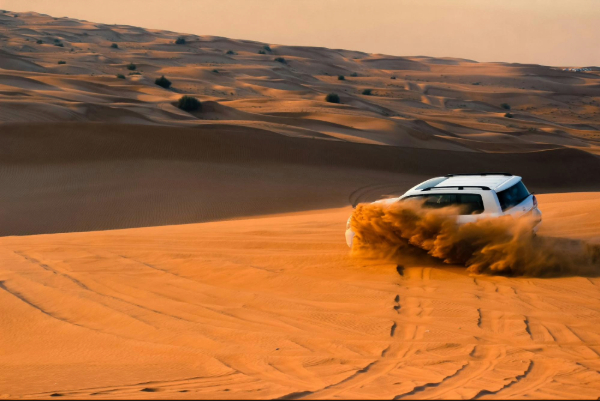
While AWD focuses on everyday confidence and convenience, Four Wheel Drive is built for capability and challenging terrain. A Four Wheel Drive system is specifically designed to handle conditions where maintaining traction becomes difficult, such as deep sand, steep slopes, rocky trails, and rugged landscapes.
Unlike AWD systems that automatically adjust power, 4WD mechanically connects all four wheels for constant traction and control. Paired with low-range gearing, it delivers better crawling capability and high handling across challenging terrain.
In the UAE, 4WD is a preferred choice for desert discoveries and outdoor adventures, delivering powerful performance and dependable traction across dunes, wadis, and rugged routes.
How 4WD Handles Off-Road Conditions
When it comes to off-road outings, 4WD stands out for its rugged reliability and superior surface grip. Specially engineered for demanding drives, the system sends engine power to all four wheels, securing stability and consistent control where standard vehicles may struggle.
In desert settings, shifting sands can quickly steal traction and stall progress. By spreading engine power across all four wheels, 4WD supports sustained speed over soft surfaces. Paired with higher ground clearance, it’s perfectly suited for dune driving, desert discovery, and rugged UAE routes.
Beyond sand dunes, 4WD systems also perform exceptionally well on:
- Rocky trails
- Steep inclines
- Uneven terrain
- Muddy surfaces
- Loose gravel roads
- Remote off-road routes
For many UAE drivers, this combination of durability, control, and capability makes 4WD the preferred choice for off-road adventures.
If you're planning frequent desert trips, it is worth exploring some of the most capable SUVs for off-road driving in the UAE.
Part-Time vs. Full-Time 4WD
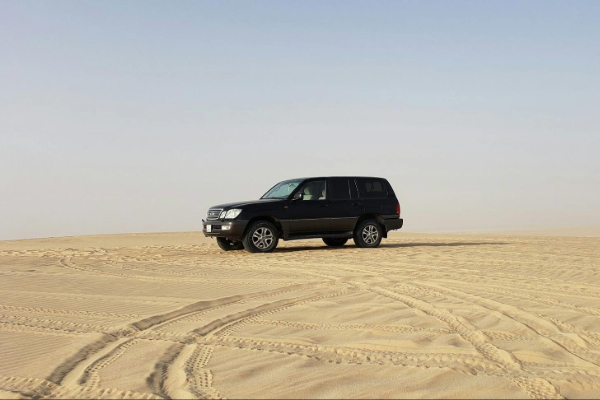
Like AWD, 4WD systems come in different designs with distinct driving dynamics.
Part-time 4WD is the most common. In daily driving, it runs in two-wheel drive, sending power to either the front or rear wheels for better efficiency. When roads get rough, the driver can switch to 4WD, allowing engine power to flow to all four wheels. This creates a smooth shift from city comfort to off-road confidence.
Full-time 4WD keeps all four wheels engaged at all times. Smart systems balance power between the front and rear, giving stability, seamless steering, and consistent control on both highways and rough terrain. Many premium SUVs enhance this with sensors and software for even better performance.
For drivers moving between city streets, steep slopes, and sandy stretches, full-time 4WD offers a capable driving experience.
AWD vs. 4WD: Key Differences Explained
When comparing AWD vs. 4WD, it’s important to know that neither is better overall, just better suited for specific scenarios.
AWD focuses on convenience and constant control. It works automatically, making it ideal for drivers who stick to smooth streets and highways but still want extra confidence when conditions change.
4WD, on the other hand, is built for power, performance, and purpose-driven capability. It’s designed for demanding drives and difficult terrain, where strong traction is essential, making it the go-to for serious off-road use.
The difference becomes clear when you consider usage. AWD suits daily drives and highway handling, while 4WD excels on dunes, dirt tracks, and tough terrain, delivering stronger stability and superior grip where it matters most.
Understanding drivetrain options is just one part of choosing the right vehicle, and many buyers also compare the differences between sedans and SUVs before making a decision.
AWD vs. 4WD Comparison Table
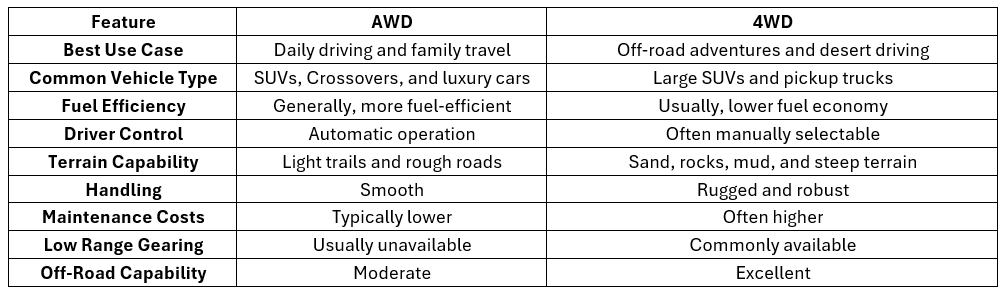
While the table highlights the main distinctions, the right choice ultimately depends on your lifestyle, driving environment, and expectations from your vehicle. For many UAE drivers, the decision comes down to balancing fuel-conscious efficiency with adventure-ready ability.
AWD vs. 4WD: Which is Better for UAE Driving?
When comparing AWD vs. 4WD in the UAE, there is no single solution that suits every driver. The better choice depends on where you drive, how often you travel, and what kind of performance you expect from your vehicle. From city commuting and comfortable cruising to desert discoveries and dune driving, both systems offer distinct advantages.
For drivers navigating Dubai, Abu Dhabi, Sharjah, and other city centers, AWD offers a comfortable and controlled drive. It automatically adjusts power between wheels, delivering steady steering on highways, lane changes, and light weather shifts, all while supporting fuel-efficient, family-friendly driving.
For those heading beyond the city, 4WD is built for rugged routes and real adventure. From Jebel Jais climbs to Hatta hills and sweeping sand dunes, it delivers powerful performance across challenging terrain.
As a general guide:
- AWD is ideal for city streets, highway travel, and family-focused lifestyles.
- AWD works well for occasional rough roads and mountain drives.
- 4WD is better suited to desert driving and serious off-roading.
- 4WD offers greater capability on sand, steep slopes, and rugged trails.
- Families who primarily stay on paved roads may find AWD more practical.
- Adventure seekers and outdoor enthusiasts often prefer 4WD.
Ultimately, the best choice is the one that matches your daily drives, weekend wanderings, and long-term lifestyle.
Popular AWD and 4WD Vehicles in the UAE
The UAE market offers diverse drivetrain options for every lifestyle, from family-friendly flexibility to adventure-ready ability.
AWD models are favored for proficient performance, comfortable cruising, and everyday capability, making them ideal for city commutes and long-distance drives. Popular picks include the Toyota RAV4, Mazda CX-5, Volvo XC60, Hyundai Tucson, and Audi Q5.
4WD vehicles, on the other hand, are built for durability, demanding drives, and desert dominance, excelling on sand and steep slopes. Leading choices include the Toyota Land Cruiser, Jeep Grand Cherokee, Toyota Prado, and Honda Pilot.
Whether you prefer smooth streets or sandy stretches, there’s a drivetrain designed for your driving style.
Explore AWD and 4WD Cars with MOOV by Al-Futtaim

Whether you're searching for a capable crossover, a family-focused SUV, or an adventure-ready off-road vehicle, Moov by Al-Futtaim makes it easier to find a car that suits your lifestyle. From city streets and smooth highways to desert routes, the right vehicle can transform every journey.
At Moov by Al-Futtaim, drivers can discover a wide selection of AWD and 4WD vehicles from trusted automotive brands. Whether you value fuel-efficient flexibility, comfortable commuting, or rugged road-readiness, you'll find options tailored to your needs.
Browse a diverse selection of SUVs, crossovers, and adventure-ready vehicles, connect with our team for clear, confident guidance, or choose the convenience of a flexible car subscription that suits your lifestyle. Contact Moov by Al-Futtaim today and start exploring roads, routes, and rugged adventures across the UAE.
Frequently Asked Questions (FAQs)
Which is better 4WD or AWD?
When comparing Four Wheel Drive (4WD) and All Wheel Drive AWD, the better choice depends on your driving demands and daily habits. AWD suits commutes, cruising, and family-focused driving, offering comfortable control and fuel-friendly efficiency.
Four Wheel Drive (4WD), which powers all wheels simultaneously, is designed for desert drives, demanding terrain, and serious off-road adventures, delivering maximum traction and more capable control.
Ultimately, the right option depends on your lifestyle, routes, and routine driving habits.
Does AWD count as 4X4?
No, AWD does not count as a traditional 4x4 system. While both send power to all four wheels, they differ in design and delivery. AWD automatically adjusts and allocates power between the front and rear wheels, while many 4x4 or Four Wheel Drive systems let drivers manually manage modes for more demanding terrain and difficult drives.
How do I tell if my car is 4WD or AWD?
The easiest way to tell if your vehicle is AWD or 4WD is by checking the manufacturer’s specs, owner’s manual, or model markings. Many AWD cars are clearly labeled “AWD” or “All-Wheel Drive,” while off-road-focused SUVs feature “4WD” or “4x4” badging. You can also spot a selector switch or terrain system, a common sign of Four Wheel Drive capability.
.png)